The automotive industry is racing towards the holy grail of fully autonomous driving, As a result, several companies, such as Waymo, Mercedes, and Tesla, have achieved high levels
of autonomous driving by investing heavily in sensor technology. New cars are equipped with sensors that have ever-higher resolutions, frame rates, and bits per pixel.
This investment, however, comes at a cost: As the amount of data needing to be transmitted grows, in-vehicle connectivity is being pushed to its limits. The sensors – be they cameras, radars, or lidars – generate massive amounts of data, and transmitting that data to a centralized compute unit is proving challenging. Simply put, there has not been a connectivity solution capable of handling the next generation of sensors, and the high bandwidth, link distance, and low latency requirements of this automotive use case.
Introducing the MIPI A-PHY standard
To address this challenge, the automotive industry has attempted to create a standardized connectivity technology for high-performance ADAS systems. The A-PHY standard, created by
the MIPI Alliance, was announced in September 2020. It offers:
- Asymmetric data link layer supporting point-to-point and zonal topologies
- 5 downlink speed gears (2, 4, 8, 12 and 16 Gbps) operating at frequencies no higher than 2GHz with roadmap to 48 Gbps and beyond
- Ultra-low packet error rate (PER) of 10-19 for unprecedented reliability over vehicle lifetime
The Robust and Growing A-PHY Ecosystem
The A-PHY ecosystem is already gaining rapid momentum with many companies having publicly endorsed the standard. These public statements have come from companies such as Tier 1s Aptiv and Denso, camera and sensor vendors such as Leopard Imaging, Nippon Chemi-Con, and Sunny Optical, SoC (System on a Chip) vendors like Mobileye, System in Package (SiP) vendors such as LG-Innotek, connector vendors such as Sumitomo, and test equipment vendors like Keysight and Advantest.
With interoperability tests between different vendors having already been successfully conducted, and OEMs, Tier 1s and Tier 2s evaluating this ground-breaking technology, it is clear that the automotive industry is adopting A-PHY as the connectivity standard of choice.
The Valens VA7000 Chipset Family
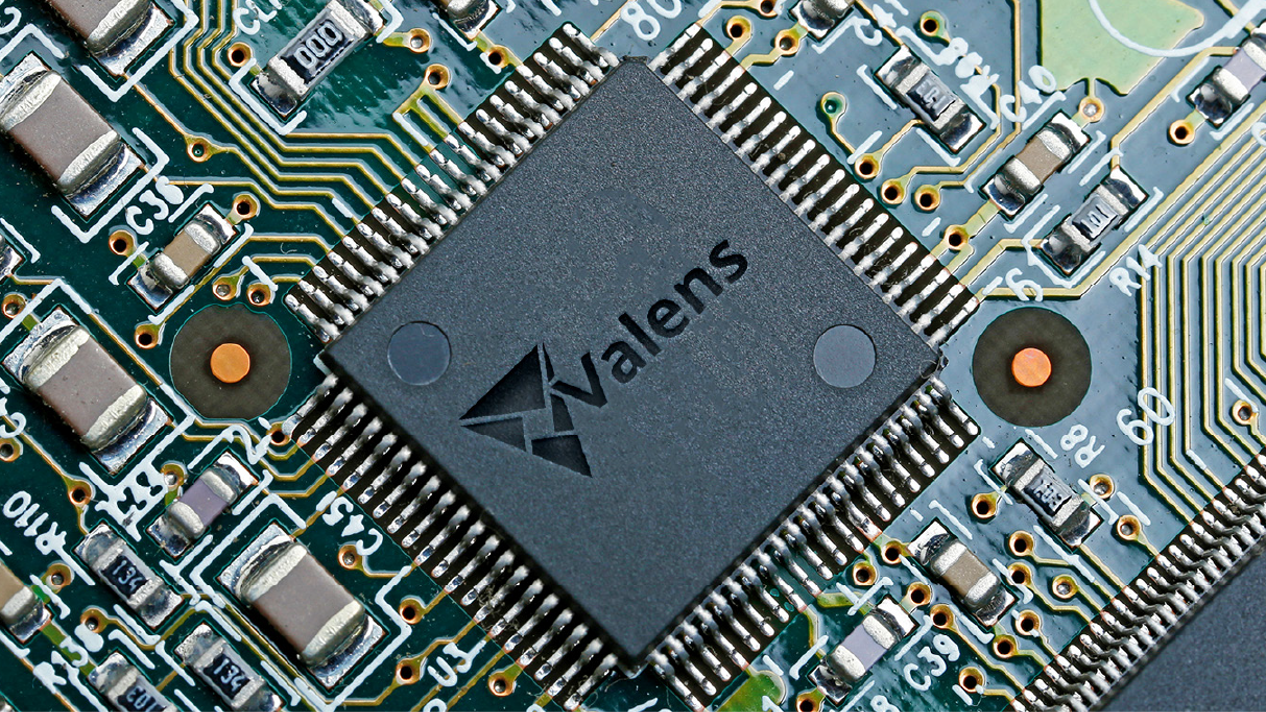
Hod-Hasharon-based Valens Semiconductor released the first chipsets on the market to comply with the A-PHY standard, the VA7000 Series. These chipsets offer ultra-high bandwidth, long distance, near-zero latency, and error-free links, enabling advances in ADAS and autonomous systems.
The VA7000 chipsets, through the MIPI A-PHY standard, will open the floodgates of innovation for OEMs and their suppliers, enabling a standardized connectivity solution that can handle the requirements of next-generation sensors and ECUs, and ultimately ushering in the era of autonomous vehicles.
For more information: https://www.valens.com/