The Launch And Recovery-Deck Handling (LAR-DH) invention is a holistic solution for fixed-wing Unmanned Aerial Vehicles (UAVs) launch and recovery that specifically addresses the shipboard recovery challenge for larger wingspan platforms. It has been invented by Meir Yoffe, who has, throughout his career, developed practical solutions for real-world UAV operational problems.
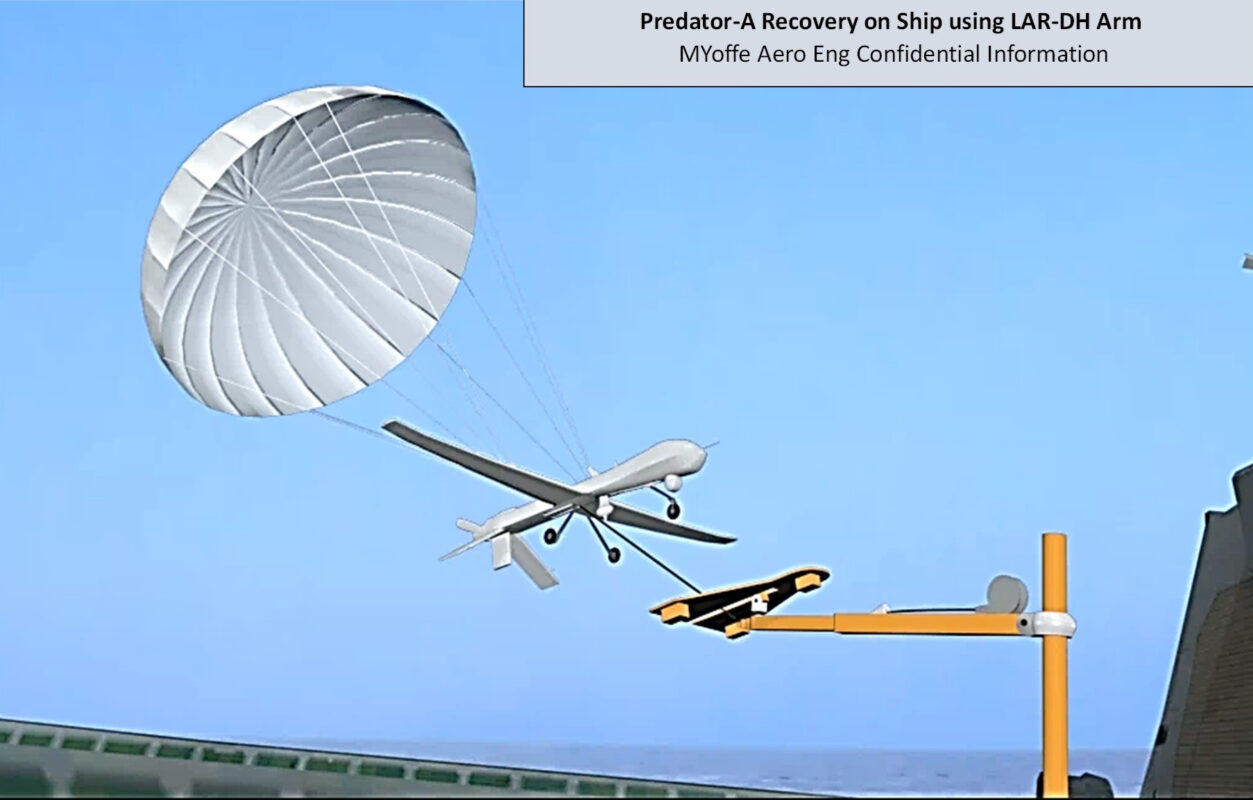
The LAR-DH recovery process begins as the UAV returns from a mission. It first makes a pass near the ship, deploys a chute, and is hauled down onto the tip adapter of a cantilevered arm extending from the ship’s side. The UAV is pulled and set down on the arm with accuracy under the cable control, and tied down for security.
The arm’s length provides the free space needed for large “Endurance” wings, solving the long-standing challenge of accommodating wide-span UAVs on the crowded decks of small ships.
Once secured, the arm rotates to place the UAV into its deck stowage, under full computer control. The stowage allows maintaining the UAV and preparing it for the next launch. It is then ready for pickup by same arm for next launching.

UAV Launching Made From Same Arm. Photo: Courtesy of Meir Yoffe.
One device for both launch and recovery
Both recovery and launch are performed by the same pole-arm device (a deliberate design goal), this solution competes effectively with new VTOL (Vertical Take-Off and Landing) UAVs for the following reasons: Requires even less deck space than VTOL systems sway in rolling- deck conditions; Offers seamless cable-tied security from the touchdown in rough sea conditions and enables mechanical transfer of heavier UAVs on deck, removing the need for manual handling thus improves safety for both UAV and the ship.
Broad compatibility and applications
The LAR-DH can handle both existing and new UAV designs, making them viable for use on standard ships without dedicated flight decks. This opens UAV operations to a wider range of vessels and missions, such as:
* Maritime ISR for military, fisheries, or ice detection
* Parcel delivery to ships far at sea
* Future applications not yet imagined
Field-tested and patented
LAR-DH has been successful at initial at-sea testing. Several patents have been granted in Israel, Europe, the US, and Asia.

Animation videos Showing UAV operations on an Australian patrol boat and on a typical European frigate, plus a list of available case solutions

About Meir Yoffe
Meir Yoffe was member of the first design team for Pioneer, Israel’s first combat UAV, developed by Israel Aerospace Industries (IAI) in the 1970s. He led the design of the Ground Control Station (GCS) and created operational concepts (CONOPS) for a type of system that had never before been built. His GCS was praised by US Navy operators during the 1991 Gulf War, where Pioneers guided ship’s artillery fire against Iraqi forces.
He also managed the design of IAI’s first TV payload for the UAV, which evolved into the MOSP line. Throughout his career, he has developed practical solutions for real-world UAV operational challenges, such as:
- Landing in 70-knot winds after a four-day stand-down due to sandstorms in Iraq (2003);
- Operating UAVs in small forest clearings surrounded by 15-meter-high trees, typical in northern latitudes..(the famous “shoe-box” requirement)
- When IAI began offering Pioneer UAVs to naval forces, there was no shipboard recovery solution. Yoffe took on the challenge and invented the LAR-DH method.

Contact:
Email – myoffe@bezeqint.net
Website: https://uav-recovery.vercel.app