A rooftop, a school courtyard or a small urban plot can become more than unused space. With the right technology, skills and market connections, it can become a reliable source of fresh food and local income. This is the opportunity driving SoliDrip, an Israeli company working with African partners to make urban farming more accessible, productive and resilient.
Founded in 2018, SoliDrip develops patented autonomous irrigation technology that responds to the needs of individual plants. Its African focus goes beyond supplying equipment: the company is building a model that brings together irrigation, organic food production, farmer training and market access, with urban smallholder livelihoods at its center. Commercially available since 2022, the technology provides an operational foundation for these projects rather than an untested laboratory concept.
Precision irrigation without power
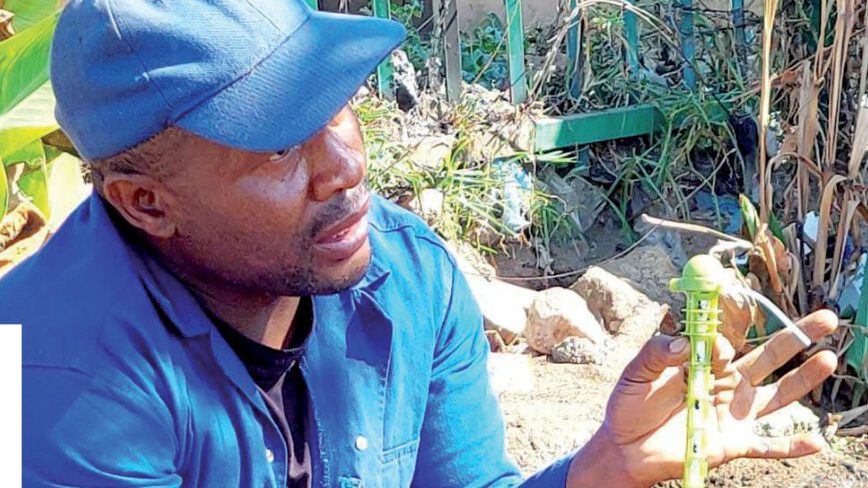
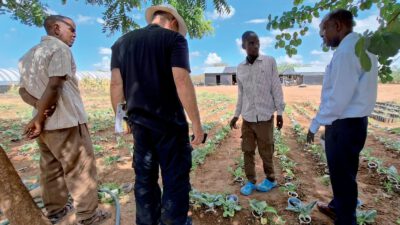
A grower demonstrates a SoliDripper
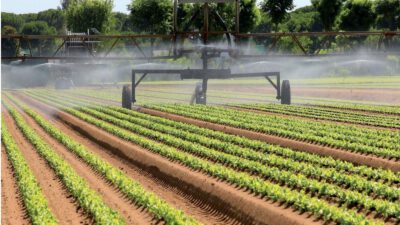
Conventional irrigation often depends on someone deciding when to water and how much to apply. SoliDrip changes that approach. Each SoliDripper responds mechanically to moisture conditions around the roots, opening and closing its valve automatically. The system requires no electricity, electronic sensors, software, internet connection or irrigation controller.
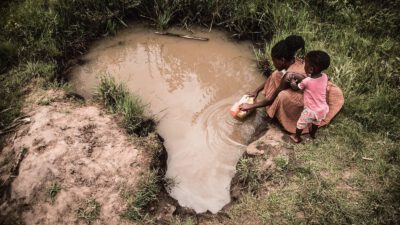
It operates at very low water pressure and can be supplied by an elevated, gravity-fed tank. This makes autonomous irrigation possible where powered control systems or pressurised water networks would be impractical, provided a suitable water supply is available.
Crucially, different plants along the same irrigation line can receive different quantities of water. A leafy vegetable, a herb and a fruiting crop need not follow one fixed schedule. The system responds as plants develop and as sunlight, wind, rainfall and temperature change moisture demand, including differences between exposed and shaded positions within the same farm.
For growers, this means less guesswork and fewer daily irrigation decisions, leaving more time for cultivation, harvesting and sales. By helping prevent both insufficient and excessive watering, the technology can reduce water stress and associated crop losses. SoliDrip reports water savings of up to 70% compared with conventional drip irrigation, depending on crops, growing conditions and the comparison system.
This is particularly useful for mixed cropping, where plants with different needs share limited space. Farmers can diversify their crop mix without creating a separate irrigation schedule for every variety. The technology does not replace sound agronomy or reliable water access; it makes one demanding part of farm management simpler and more responsive.
From South African experience to Kenyan rooftops
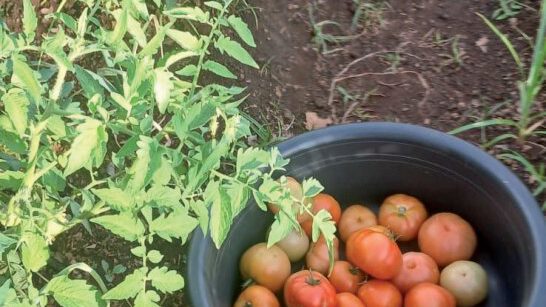
Vegetable production in growing bags makes use of a compact outdoor space
In Soweto, South Africa, SoliDrip has completed two urban-farming pilot cycles supported by a $25,000 grant through JDC’s Innovation Journey. Working with local community partners, the initiative explored mixed cropping and cultivation in growing media separate from the ground. These experiences helped demonstrate how autonomous irrigation can support food production in space-constrained community settings.
The next stage is taking shape in Kibera, Nairobi, where SoliDrip is developing a rooftop-farming program linked to affordable housing. The first phase is planned around two 170-square-meter rooftop farms, supported by $175,000 in funding from the Livelihood Impact Fund, administered through Founders Pledge.
The program combines Israeli technology with Kenyan implementation and knowledge. Kenyatta University supports research and evaluation, while City Shamba contributes farmer training, agricultural inputs and access to organic produce markets. SoliDrip brings irrigation technology, project coordination and technical support. Together, the partners aim to turn rooftops into productive spaces that create employment and generate income from fresh vegetables, herbs and other suitable crops. The emphasis is on learning what works locally: crop performance, water consumption, operating costs, workforce skills and buyer demand. The farms are intended to establish an evidence base for expansion, not simply demonstrate equipment. Their commercial and social results will help determine how the model should develop.
Building livelihoods, not isolated installations
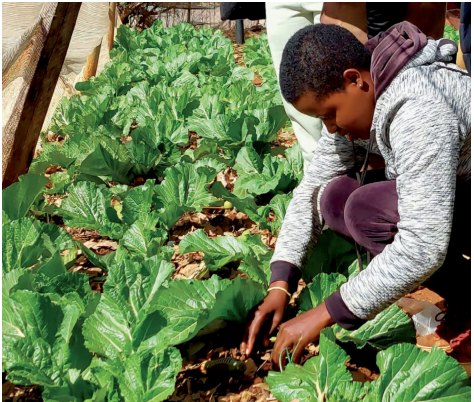
A grower tending leafy vegetables in a compact growing area
Reliable irrigation is essential, but it cannot create a successful farming business alone. Growers also need suitable inputs, practical training, crop planning and dependable routes to customers. SoliDrip’s approach therefore connects individual farms through shared services, including agronomic support, procurement, quality management, packing and logistics.
This cluster model is designed to help small urban farms work together without losing their local connection. Coordinated production can serve buyers more consistently, while shared resources can lower costs. Growing close to consumers also creates opportunities for shorter supply chains and fresher produce.
Philanthropic funding helps finance establishment, training and early operation. The longer-term objective is for produce sales to sustain the farms and, where agreed with funders, enable capital to be reused for additional sites. Financial sustainability is central to the impact: the ambition is lasting livelihoods rather than permanent dependence on donations.
The climate contribution is practical: use scarce water more carefully, respond to changing growing conditions and support production without power-dependent irrigation control. Combined with appropriate site design, these capabilities can help communities manage resource constraints while developing new economic opportunities.
An invitation to collaborate across Africa
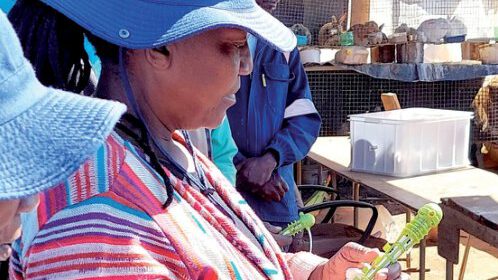
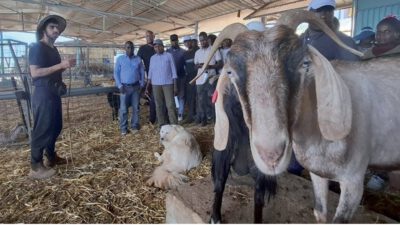
Participants examine SoliDrippers during a field demonstration
Photos: courtesy of SoliDrip
SoliDrip is seeking partners who can help adapt and extend this approach to additional African cities. Municipalities, universities, community organizations, housing developers, agricultural businesses and impact funders can each contribute local knowledge, sites, training, finance or market connections.
For Israeli embassies across Africa, the initiative offers a practical opportunity to connect Israeli innovation with locally defined priorities. By bringing the right partners together, underused urban spaces can become places where food production, enterprise and climate resilience grow side by side.

For more information:
Gad Marton CEO and Co – founder +972545221282 ● gad@solidrip.com